Metz Day Trip from Luxembourg: A Full Guide
Metz in a Day: The Trip 45 Minutes from Luxembourg That Nobody Talks About
Ask most people in Luxembourg where to go for a day out and you'll hear Trier, Saarburg or Ikea next to Arlon. Metz rarely comes up — which is strange, because it's closer than almost all of them, it has a cathedral with more stained glass than any other in Europe, a Centre Pompidou, and a covered market that would be a destination in its own right anywhere else.
It's 45 minutes away. Here's how to do it in a day.
Getting there
By train. Direct from Luxembourg Gare Centrale to Metz-Ville. The fastest services take 42 minutes, most take around 55, and they run roughly hourly throughout the day. Singles start around €11 if you book ahead.
The ticket worth knowing about: CFL sells a combined return ticket from any Luxembourg station plus entry to all Centre Pompidou-Metz exhibitions for €24.80. Buy it at a CFL ticket office or HERE online. If the Pompidou is on your list, this is comfortably the cheapest way to do the day — the entry alone is normally around €12, and a walk-up return fare will cost you more than the difference.
By car. Around 40 minutes down the A3 and the A31. Parking in the centre is paid but not painful. The train is genuinely better here — you arrive in the middle of everything and don't have to think about it.
One thing to check: Metz-Ville station is itself worth two minutes of your attention. Built under German rule in the 1900s, it's an enormous neo-Romanesque statement in Jaumont stone, and it was voted France's most beautiful station a few years ago. Don't walk straight out.
Start with the cathedral
Cathédrale Saint-Étienne is the reason to come, and it's free to enter.
The numbers do most of the talking: roughly 6,500 m² of stained glass, the largest expanse of any cathedral in Europe, spanning eight centuries — from a 13th-century rose window over eleven metres across, to Renaissance work by Valentin Bousch, to three series of windows by Marc Chagall, made between 1958 and 1970. The nave rises 41 metres. Locals call it la Lanterne du Bon Dieu — God's Lantern.
Go in the morning. The light through the Chagall windows in the north transept is dramatically better before midday, and the cathedral is quietest then. Generally open from 8:00, though it closes over lunch on some days and Sunday mornings are given to services.
The crypt and treasury cost extra (around €9) and are worth it if you like that sort of thing — the treasury holds the Cope of Charlemagne, recovered from a Bavarian salt mine after the Second World War. If you're short on time, skip them. The nave is the event.
Allow an hour, more if you linger.
Then the covered market
Marché Couvert, directly beside the cathedral, in a building originally intended to be the bishop's palace before the Revolution intervened.
This is where Metz feels most like itself. Cheese, charcuterie, bread, produce, and a handful of counters where you can eat standing up. It's a working market for local people, not a tourist attraction, and it's the best possible place to assemble lunch or eat an early one.
Closed Sundays and Mondays. Worth building your day around — a Tuesday to Saturday trip gets you the market, a Sunday trip doesn't.
The Centre Pompidou
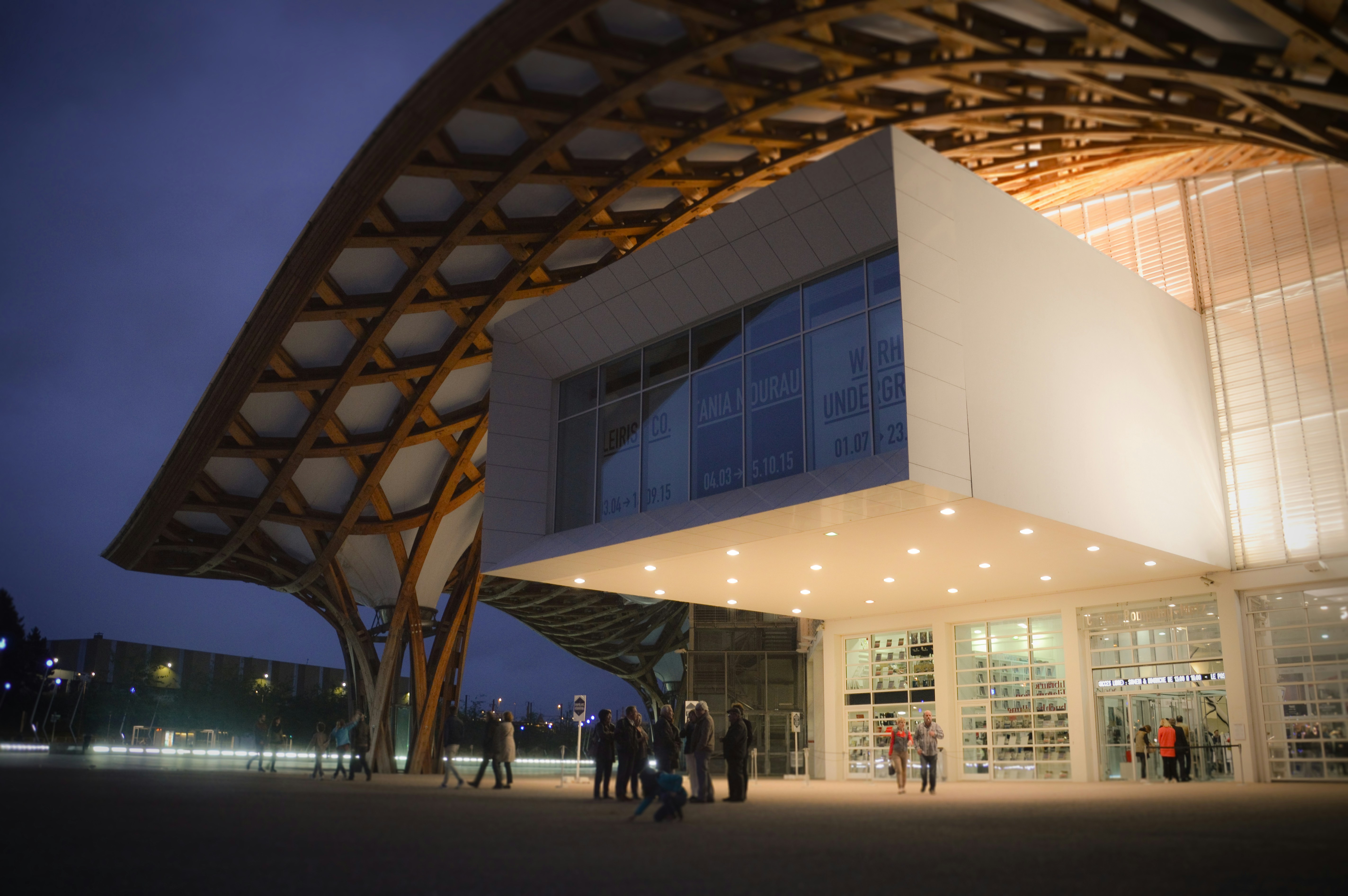
Ten minutes' walk from the station, in a building by Shigeru Ban with a woven timber roof that looks like a vast hat and is genuinely one of the more interesting pieces of modern architecture in the region.
Opened in 2010 as the first offshoot of the Paris Centre Pompidou, it runs three or four major temporary exhibitions a year and draws around 300,000 visitors annually — a good number of them from across the border.
Practical details:
- Closed Tuesdays
- Open 10:00–18:00, until 19:00 Friday to Sunday from April to October
- Last admission 30 minutes before closing
- Entry around €12, or €7 on Mondays with a validated LE MET' ticket
- Or use the €24.80 CFL combined ticket mentioned above
Allow two hours. Check what's on before you go — the whole building is temporary exhibitions, so the experience varies enormously depending on timing.
Walk the rest
Metz rewards aimless walking more than most cities this size.
Place Saint-Louis — arcaded medieval square, former money-changers' houses, good for a coffee.
Place d'Armes — the formal 18th-century square beside the cathedral, all cafés and symmetry.
Quartier Impérial — the German-built district around the station, laid out between 1871 and 1918. Wide boulevards, heavy stone, and an architectural language that feels distinctly un-French. It's a UNESCO candidate and the most historically interesting part of the city if you know what you're looking at.
The Temple Neuf and Jardin d'Amour — Protestant church with the gardens beside it giving you the postcard view of the cathedral rising over the water. Best in late afternoon light. You should check your location on Google Maps to see what is so special about it.
Porte des Allemands — the fortified medieval gate on the eastern edge, more castle than gate. Free to walk through.
What to eat
Metz is in Lorraine, so the obvious answer is the right one.
Quiche lorraine — the actual thing, in the actual place. Eggs, cream, lardons, pastry. No cheese. Anyone adding cheese in Lorraine is doing something else.
Pâté lorrain — pork and veal in puff pastry, sold in bakeries everywhere, ideal for eating while walking.
Mirabelle plums — the regional obsession. If you go in late August or September, you'll find them fresh, in tarts, in jam, and as eau-de-vie. The mirabelle harvest is Lorraine's genuine seasonal event.
Macarons de Metz — flatter and chewier than the Parisian sandwich version, and older.
For a sit-down lunch, the streets around Place Saint-Louis and Place de Chambre have plenty of options without needing a reservation.
I recommend looking at reviews first as you might risk ending up in a tourist trap!
A sensible day
09:00 — Train from Luxembourg 09:45 — Arrive, look at the station properly 10:00 — Cathedral, while the light is good 11:15 — Covered market, assemble or eat lunch 12:30 — Walk: Place Saint-Louis, Place d'Armes, Quartier Impérial 14:00 — Centre Pompidou 16:00 — Temple Neuf and the gardens, coffee somewhere 17:30 — Train home
Adjust freely. The point is that a day is genuinely enough for Metz, and you're back in Luxembourg for dinner.
What to avoid
Don't go on a Tuesday. The Centre Pompidou is closed.
Don't go on a Sunday or Monday if the market matters to you. It's shut both days.
Don't arrive expecting everything open at midday. France still takes lunch seriously, and smaller shops and some cathedral areas close between roughly 12:00 and 14:00.
Don't try to add Nancy. People do, and it doesn't work. Nancy deserves its own day.
Don't skip the German quarter because it's near the station and looks like somewhere you pass through. It's one of the most distinctive things about the city.
Why it's worth it
Metz spent centuries being fought over, and it shows — a French Gothic cathedral, a German imperial district, a Japanese-designed art museum, all within a twenty-minute walk. For a city of 120,000 that's an unusual density of things worth looking at.
And it's 45 minutes from Luxembourg-City. There is very little excuse.
The Lux List is a free fortnightly newsletter covering travel deals, money moves and life across Luxembourg and the Greater Region — in English. Join here.